Daxianghu
The EmigrantsThe Atlantic is the central sea crossing in the emigrants’ journey aboard the Charlotta, a space where the hope of reaching a new home meets the bodily limits of an overcrowded ship and the uncertainty of wind, weather, and distance. First encountered from a shore without land on the far side, the ocean becomes both a material obstacle and an image of migration’s unsettled interval: the old home recedes, while the new one remains beyond sight.
Route and Scale
The emigrants’ passage was arranged as a direct voyage from Karlshamn to New York, without an intermediate harbor. The Charlotta sailed on April 14, 1850, with 78 emigrants among 94 people aboard, carrying pig iron and other goods. The crossing was timed for spring: the winter storms had passed, and an arrival early enough in summer would allow the travelers to till and sow before winter. Yet the practical plan could not control the sea. Contrary winds, currents, and fog extended the voyage, making its distance legible less as miles than as the accumulating days since departure.
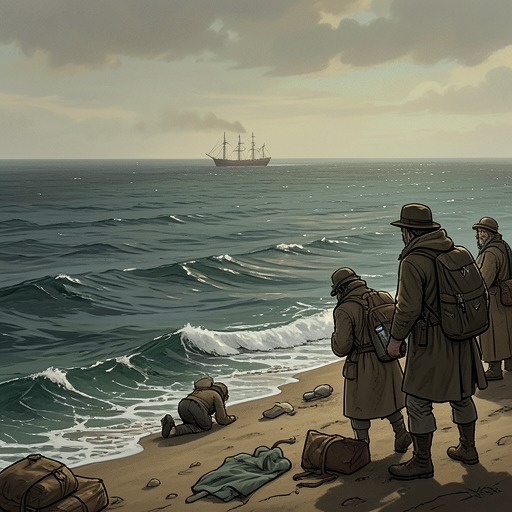
Before embarking, the travelers had known the ocean chiefly through rumor and pictures. At the coast, they confronted water without land visible on the opposite side, and a cold wind that seemed to challenge them to come out upon it. That first view marks a threshold: people accustomed to land-based life had reached the element on which their passage depended, but it offered no familiar landmarks or assurance of arrival.
A Ship at Sea
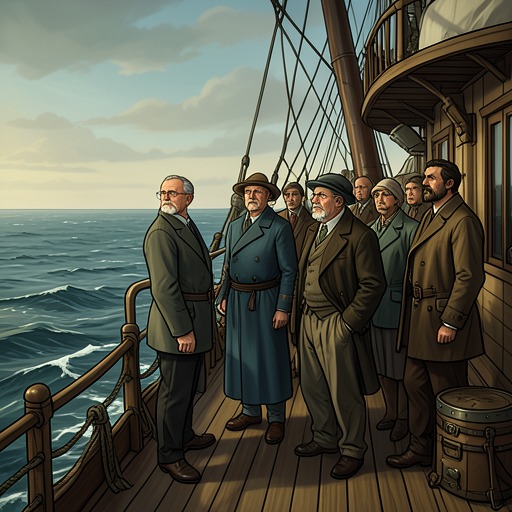
The ocean’s scale is rendered through the Charlotta’s cramped dimensions. The emigrants paced the brig and reckoned it at roughly forty paces long and eight wide, space for nearly a hundred people to sleep, eat, and perform the necessities of life. Below deck, canvas partitions divided married families, unmarried men, and unmarried women. Bedding, baskets, tubs, and bundles crowded the low, choking hold; light entered through the main hatch, and at night weak, smoking kerosene lanterns offered little relief. With no room in the family compartment, Karl Oskar shared a two-man bunk with Robert, beside Jonas Petter and Arvid.
Shipboard life was governed by scarcity and command. Each family received a weekly allotment of unprepared provisions and had to take turns cooking in the galley. Passengers were allowed only half a gallon of fresh water per person each day, for drinking, washing, and preparing food; the supply was withheld until they had cleaned the hold after the night. They were warned to throw refuse overboard on the leeward side, to use fire cautiously, and to obey the captain’s orders. These rules made the crossing not an open expanse of freedom but a tightly managed existence whose passengers depended on ship, crew, and rationed supplies.
The contrast between deck and hold sharpened that dependence. During the day, passengers sought fresh air on deck, wrapped in all their coats, shawls, blankets, and sheepskins against the cold. At night, the hold’s fetid air and seasickness made rest difficult; after dark, lights were forbidden, and the morning cleaning revealed what the night had left behind. The women tried washing woolens in seawater, but soap would not lather. When rain fell, sailors stretched a sail to collect water, and Danjel interpreted the welcome supply as a provision remembered by the Lord.
Distance, Isolation, and Imagery
The narrative transforms the Atlantic into a barren water-desert. The emigrants’ ship is figured as a rolling camel in a sailing caravan, carrying them across an empty wilderness like that traversed by the children of Israel in search of the Promised Land. The comparison gives the crossing a scriptural scale, but it does not make the journey easy or certain: the desert is formidable, monotonous, and without the signs of spring the travelers associate with home. In May, the hills they have left would be flowering, while around them the waves offer no blossoms or familiar ground.
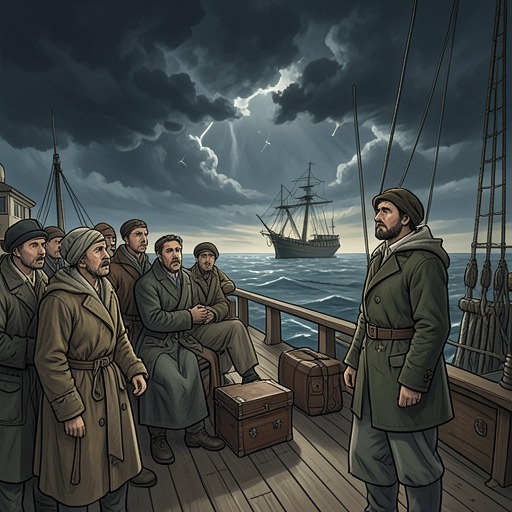
Wind and fog turn time into an ordeal. After two months at sea, the passengers had seen only one other ship since the English shore disappeared, and no human life beyond the rail of their own vessel. They felt like sea-vagabonds, forgotten by the world, and feared that someone might still miss them in the homeland while nobody awaited them at their destination. Contrary winds seemed to push the Charlotta backward; when fog cleared, the west wind still delayed the ship. The travelers counted the ocean not in measured miles but in long, accumulating days, with both the land left behind and the hoped-for land ahead seeming remote.
A spring afternoon briefly offered a gentler face of the passage: the Charlotta sailed leisurely under a moderate wind while the May sun shone over the Atlantic. Yet even this interval retained the ship’s material discomforts: the galley’s penetrating smell of fried rancid pork accompanied passengers sitting in small groups on deck. Robert and Elin read together from his English guidebook, slowly working through its pages. The scene places study and private companionship inside the larger crossing, where the language of the destination is being learned while the destination itself remains unseen.
Meaning in the Crossing
The Atlantic gives physical form to the distance between leaving and belonging. The emigrants have traveled away, but they cannot yet imagine that the place ahead will become home. Their journey is therefore more than transit: it suspends them between two worlds, with the familiar landscape reduced to memory and the promised settlement still beyond the horizon. The ship’s narrow confines intensify the paradox. They cross a vast ocean together, yet their immediate world is a crowded hold, a ration of water, and a deck bounded by sea.
By joining migration’s imagined promise to its actual conditions, the ocean complicates the idea of a straightforward escape. It is the necessary route to the hoped-for land, but it also exposes the emigrants to delay, discomfort, and isolation beyond their control. The longer the Charlotta remains at sea, the more the Atlantic becomes not simply the distance to a new home but the uncertain interval in which the travelers must endure having left the old one.